





MARTIN LUTS A MATTER OF PERSPECTIVE
 -
-  Haus Gallery
“The most perfect way to explore the universe is the one opened by mathematics, and especially geometry,” said René Descartes (1596–1650), the French mathematician and philosopher who laid the foundations of analytic geometry and introduced the coordinate system, enabling geometric forms to be described through algebra.
Geometry is one of the most important frameworks of the practical world, marking the system into which the material world existing in space and time is placed in order to better understand, analyze, and situate it within a broader frame of reference. Yet geometry is also, in its own way, a philosophical foundation of independent thought, offering playful possibilities for interpretation in creative fields.
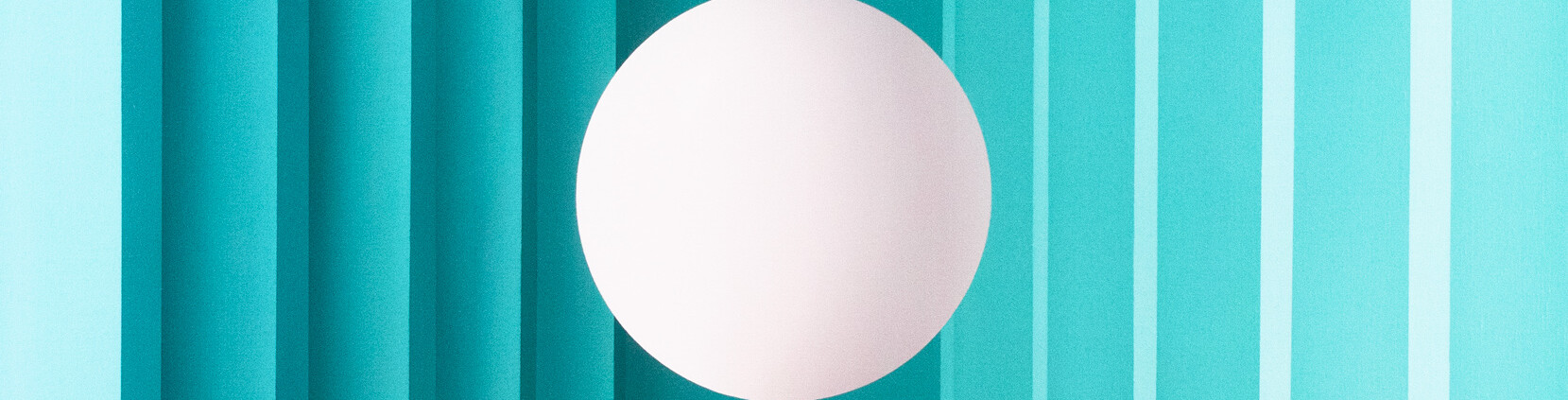
Martin Luts has found a personal challenge in geometric forms, painting mathematically precise objects that relate to one another from different viewpoints, as if asking whether perspective itself can transform an object into something else, or whether such apparent transformation exists only in the eyes and minds of the viewer. More broadly, the exhibition engages with questions of perception, whether through the optical illusions generated by Luts’s geometry or the shifts in thought that emerge from the viewer’s own analytical process.
The artist presents a series of works inspired by the same geometric form, creatively varying the point of view: front, back, side, or direct view; large, small, or medium-sized. Through his meticulous approach, he invites viewers to think alongside him and to exhaust the possibilities of a single visual vocabulary—if such possibilities can ever truly be exhausted.
Martin Luts’s geometric perspectives are inexhaustible. Analyses that appear fully explored can always be begun again, viewed from a slightly different angle and stored anew in the mind. This geometric perspective may seem theoretical, yet it extends far beyond abstract forms. It can be applied to ourselves, to relationships, and to the emotions we create or that are created through and around us. In this way, we may see ourselves and others as simultaneously the same and infinitely different. Every new person, just like every new situation, amplifies entirely new constellations of the self within us. The ideas and world of Martin Luts’s paintings cast us into a geometric kaleidoscope, which, when shaken, reveals not only seemingly endless combinations of color but also countless configurations of cylinders, cubes, spheres, and polyhedra—solutions for life and for the self.
The artist describes this body of work as follows:
“Throughout this exhibition, forms recur from different viewpoints and within different spaces: in deep shadow, gray light, and creamy balance. The light changes, the space changes, and the way we experience the image changes. The forms remain the same, yet the relationships between them, their center of gravity, and their meaning are transformed.
The same composition can change completely depending on the point of view.
The works do not depict specific objects but rather ways of seeing. The geometric forms appear both precise and unreal at the same time—like ideas attempting to become visible for a brief moment.
At the heart of the exhibition lies not only form, but also a question: How much of what we see depends on where we stand? Does every perspective create its own version of the visible world?
And one additional note: although these are abstract compositions, one may still sense the presence of a human being within them.”
Martin Luts graduated from the Faculty of Mechanical Engineering at Tallinn University of Technology, earned a master’s degree in business administration, and studied in open courses at Estonian Academy of Arts. Throughout his life, he has maintained a deep interest in geometry, refining it to a high level of precision in his oil paintings.
The artistic practice of Martin Luts explores the relationship between ideal form and the material world, centering on the autonomous field of meaning inherent in form itself. His work is grounded in a realist philosophical premise that form possesses its own significance independent of the viewer’s gaze or interpretation. Luts employs geometric figures as conceptual tools through which to investigate questions of perfection, order, permanence, and beyond.
Text: Piia Ausman

Participated in exhibition A MATTER OF PERSPECTIVE -

Participated in exhibition A MATTER OF PERSPECTIVE -

Participated in exhibition A MATTER OF PERSPECTIVE -

Participated in exhibition A MATTER OF PERSPECTIVE -

Participated in exhibition A MATTER OF PERSPECTIVE -

Participated in exhibition A MATTER OF PERSPECTIVE -

Participated in exhibition A MATTER OF PERSPECTIVE -

Participated in exhibition A MATTER OF PERSPECTIVE -
 Reserved
Participated in exhibition A MATTER OF PERSPECTIVE -

Participated in exhibition A MATTER OF PERSPECTIVE -

Participated in exhibition A MATTER OF PERSPECTIVE -

Participated in exhibition A MATTER OF PERSPECTIVE -

Participated in exhibition A MATTER OF PERSPECTIVE -

Participated in exhibition A MATTER OF PERSPECTIVE -

Participated in exhibition A MATTER OF PERSPECTIVE -

Participated in exhibition A MATTER OF PERSPECTIVE -

Participated in exhibition A MATTER OF PERSPECTIVE -

Participated in exhibition A MATTER OF PERSPECTIVE -