






NINA DOSHE CROWNED WITHIN HERSELF
 -
-  Haus Gallery
Ukrainian-born Nina Dobrovolska, known under the artist’s pseudonym Nina Doshe, graduated from the Estonian Academy of Arts in 2018 as a graphic artist. Today she is recognized as a professional painter whose masterful and romantic creative handwriting has caught the public’s eye through the display windows of numerous exhibition halls both in Estonia and abroad. Doshe last exhibited her works at Haus Gallery in 2021.
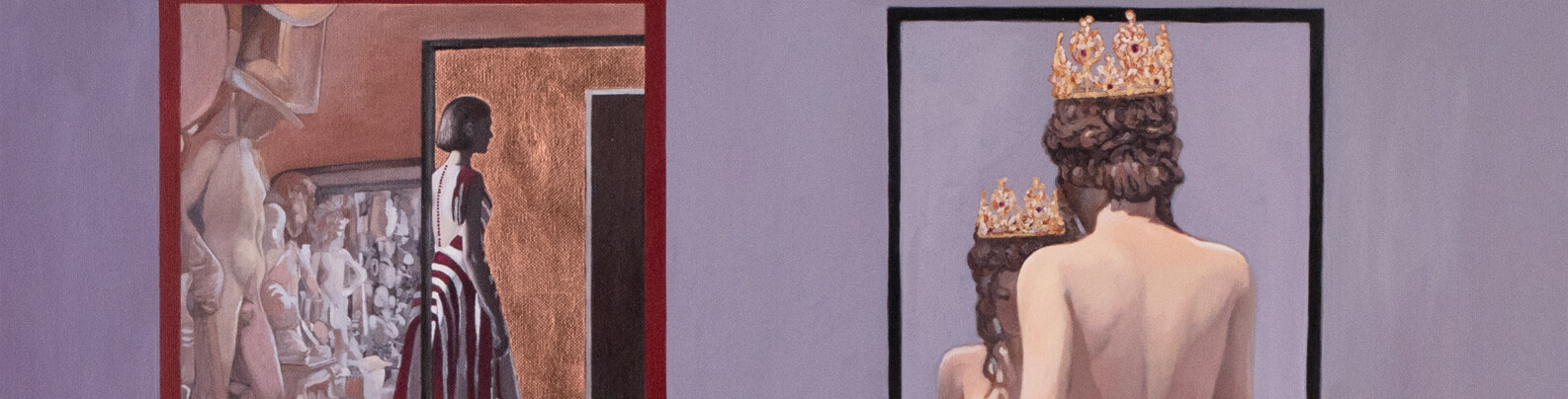
The exhibition “Crowned Within” is a substantial, sensitive, and conscious, as well as a carefully considered, view into the world of being a woman. It is articulated through royal metaphors—elegant figures, lush flower bouquets, and architecture aspiring upward—combined with a distinctly academic, realistic, yet personally metaphysical painterly style.
Nina Doshe cherishes life’s beautiful manifestations through a feminine touch, gaze, and hand. Her oeuvre today aligns more with the axis of continuity in painting rather than rupture, being technically masterful and rich in painterly detail, emphasizing the aesthetics of beauty as a whole.
Doshe’s painterly language is clear and balanced. Her compositions are built upon firm classical principles, and her use of color is soft and carefully considered. The artist does not seek provocation, but depth. Her works resemble concentrated spaces of silence, where what is depicted acquires a deeper meaning beyond the first glance.
The starting point of this exhibition lies in the artist’s external and inner journeys. Thus, the “geographical” experiences in her Southern France paintings are not expressed as direct travel narratives, but rather as atmospheres, inner dialogues, and sensations. The historical dignity of England and the Mediterranean light create backgrounds imbued with reflections of the artist’s personal experience. While the painting “Parfumerie Maison de Godet. Saint Paul de Vence” conveys the refined tradition of old European perfumery, allowing the viewer to sense the scents of that time and place, a lush still life carries the experiencer far beyond mere object-based composition, inspiring an empathetic immersion into bygone eras of reverence for the beauty of blossoms in both life and art.
Alongside the experienced places and their memories, feelings, and perceptions, the central motif of the exhibition is the woman—an inwardly crowned, dignified woman whose multilayered beauty the artist idealizes in her paintings. To a certain extent, Nina Doshe continues a dialogue here with her own earlier work, referring to a queen motif painted more than five years ago. Whereas the earlier interpretation of the queen carried the energy of movement and decisiveness, the present state has calmed. The focus is no longer on ascent and ruling height, but on dignified presence. The mirror, crown, and chessboard in Doshe’s queen painting form a symbolic space in which choice, destiny, and self-awareness are contemplated. These are not merely decorative details, but parts of a larger and far more meaningful structure. The chess motif refers less to a game than to a strategy that a woman employs throughout her life in her conscious self-formation. The mirror, in this context, does not pass judgment, but affirms and acknowledges the woman’s already existing identity.
Doshe’s approach to femininity is not declarative. Rather, it is a quiet yet consistent act of self-positioning. Vulnerability and dignity coexist within the same imagery without opposing one another, creating an inner tension in the paintings without external dramatization.
The exhibition “Crowned Within” does not speak of power in its traditional sense. It speaks of maturity—a state in which a person no longer seeks external validation for their essential existence, but relies on an already discovered inner balance. In Doshe’s work, this is expressed through the calm composition of the paintings, carefully considered formal solutions, self-contained figures, self-evident motifs, and the timeless atmosphere of everything depicted.
As a whole, the exhibition resonates as an emotionally experiential space. It does not demand a quick reaction, but rather presupposes time—time that the viewer takes calmly and without haste. It is precisely in this slowness that the most important message of the exhibition unfolds, speaking of dignity as an independent quality of existence itself, one that requires no proof.
Text: Piia Ausman

Participated in exhibition CROWNED WITHIN HERSELF -
Participated in exhibition Step of the Queen -
 Not available
Participated in exhibition CROWNED WITHIN HERSELF -
 Not available
Participated in exhibition CROWNED WITHIN HERSELF -
 Not available
Participated in exhibition CROWNED WITHIN HERSELF -
 Sold
Sold
Participated in exhibition CROWNED WITHIN HERSELF -
Sold 2026
 Sold
Sold
Participated in exhibition CROWNED WITHIN HERSELF -
Sold 2026
 Not available
Participated in exhibition CROWNED WITHIN HERSELF -
 Not available
Participated in exhibition CROWNED WITHIN HERSELF -
 Not available
Participated in exhibition CROWNED WITHIN HERSELF -
 Sold
Sold
Participated in exhibition CROWNED WITHIN HERSELF -
Sold 2026
 Sold
Sold
Participated in exhibition CROWNED WITHIN HERSELF -
 Not available
Participated in exhibition CROWNED WITHIN HERSELF -

Participated in exhibition CROWNED WITHIN HERSELF -
 Not available
Participated in exhibition CROWNED WITHIN HERSELF -
 Sold
Sold
Participated in exhibition CROWNED WITHIN HERSELF -
Sold 2026

Participated in exhibition CROWNED WITHIN HERSELF -
 Sold
Sold
Participated in exhibition CROWNED WITHIN HERSELF -
 Not available
Participated in exhibition CROWNED WITHIN HERSELF -
 Not available
Participated in exhibition CROWNED WITHIN HERSELF -
 Sold
Sold
Participated in exhibition CROWNED WITHIN HERSELF -
Sold 2026
 Not available
Participated in exhibition CROWNED WITHIN HERSELF -

Participated in exhibition CROWNED WITHIN HERSELF -
 Sold
Sold
Participated in exhibition CROWNED WITHIN HERSELF -
Participated in exhibition Step of the Queen -
 Sold
Sold
Participated in exhibition CROWNED WITHIN HERSELF -
Participated in exhibition Step of the Queen -