





MALL NUKKE MALL NUKKE COLLAGE
 -
-  Haus Gallery
Haus Gallery presents an exhibition dedicated to Mall Nukke’s 60th birthday, showcasing her well-known and distinctive collage art. The exhibition spans two floors: one gallery room looks into the past, featuring works created more than a decade ago, while the other focuses on the present, displaying pieces completed earlier this year. Mall Nukke, a classic of contemporary Estonian art who emerged on the art scene during the iconic early 1990s, remains a compelling and socially perceptive artist – both then and now.
Mall Nukke’s Collages 2009–2024
Mall Nukke calls herself a collage artist who occasionally paints. Collage is her greatest passion, and it’s something she has returned to full circle, now as older and wiser. Regardless of whether she picks up a paintbrush or scissors and glue, her first steps always begin with a pencil. Everything starts with drawing: the placement and positioning of elements on the surface, composition. Just like rhythm in music. It’s a kind of invisible thread tying together instruments and solos, background and foreground. Her technique – or rather, the combination of techniques – is unique and unmistakable, thanks in part to this rhythm, but not only because of it.
Some ideas call for one technique, others for another. The choice of medium is driven by the concept, and not every idea is meant to come to life. On the cover of her previous collage catalogue stood her iconic 2009 portrait of Marilyn Monroe – an Andy Warhol – inspired piece that, in fact, conceals a completely different painting underneath. There are a few other works like that – ones the artist herself felt were better left unseen. But I dare predict that in the distant future, Mall Nukke will be one of those artists whose works are studied and scanned by restorers and conservators to uncover what lies between and beneath the layers. And then it will be their turn to present their own findings – what secrets Marilyn may have carried all these years.
I also leave a note for future art historians: take a closer look at the fate of the monumental collages from 1996–1997 that once adorned the walls of Club Hollywood. All the film stars depicted on those murals were eventually swept away by new trends and changes. As time passed, the club interiors were redesigned – the collages were painted over, came unglued, and fell apart. Was this ignorance or simply a paradox of capitalism – something the artist herself explores in her work? Is it still possible to find the one surviving panel, the one that portrayed our own local socialite, Beatrice, and initially escaped defacement? In any case, it’s a phenomenon worth exploring in the broader context of commission-based art and its preservation.
Marilyn and Beatrice are both idols and icons – keywords that have been recurring and sometimes overlapping concepts in Mall Nukke’s work. If “idol” leans toward kitsch and cliché, then “icon” speaks to power and wealth – both satirized and transcended. She has also drawn inspiration from Old Russian religious icons, borrowing their sacred format – from thick wooden frames to gold leaf, crackling, and aging. This painstaking technical process carries its own narrative, one that can be interpreted both religiously and secularly, in historical as well as contemporary terms. Today, however, Nukke’s icons lean more toward painting and have receded from the collage context.
Even Marilyn seems to have left behind her iconicity – depicted again in 2023, but no longer as a superstar. Mall Nukke now presents her in collage as a flesh-and-blood person, under her given name, Norma. Her gaze is no longer seductive; she doesn't squint alluringly, her lips are barely parted, and her chin no longer juts out provocatively. A similarly understated and natural tone marks the 2023 portrait of a young Elizabeth II, using her childhood nickname “Lilibet.” A transformation has also occurred with Marlene Dietrich, whom Mall Nukke had previously portrayed as a mythological Venus or even a comical Mickey Mouse figure. In 2024, Dietrich appears without any props – as a dignified, self-assured, and fateful woman. Yes, she still seduces.
A sense of formal independence and seriousness is also evident in portraits of famous Estonian poetess Lydia Koidula and writer Anton Hansen Tammsaare. Their faces were once affixed to humorous nude images with dollar signs, but in 2009, they’re portrayed as stoically as we remember them from the era of the Estonian kroon. Wait, did I say kroon? Why, then, are their backgrounds filled with euros? This ability to mix and shift semiotic symbols is as essential a tool in Mall Nukke’s toolbox as pencil, brush, scissors, or glue – and over time, perhaps even more so. Her technique has become more uniform and flat, while her content has grown deeper and more refined.
In broad terms, one could say that where earlier her collages were filled with colorful middle-class ideals, media and entertainment imagery, ancient mythology and modern archetypes, her recent themes have become increasingly metaphysical and surreal. They no longer scream in your face or kick doors open, they invite you in quietly. Time – both unstoppable and unrelenting – has taken center stage, ticking in the background as the creation of the world and our frantic running in circles unfold. Mall Nukke can convincingly create a scene of urban romance or eroticism, as well as a rabbit hole revealed between twisted tree roots – one you enter at your own risk.
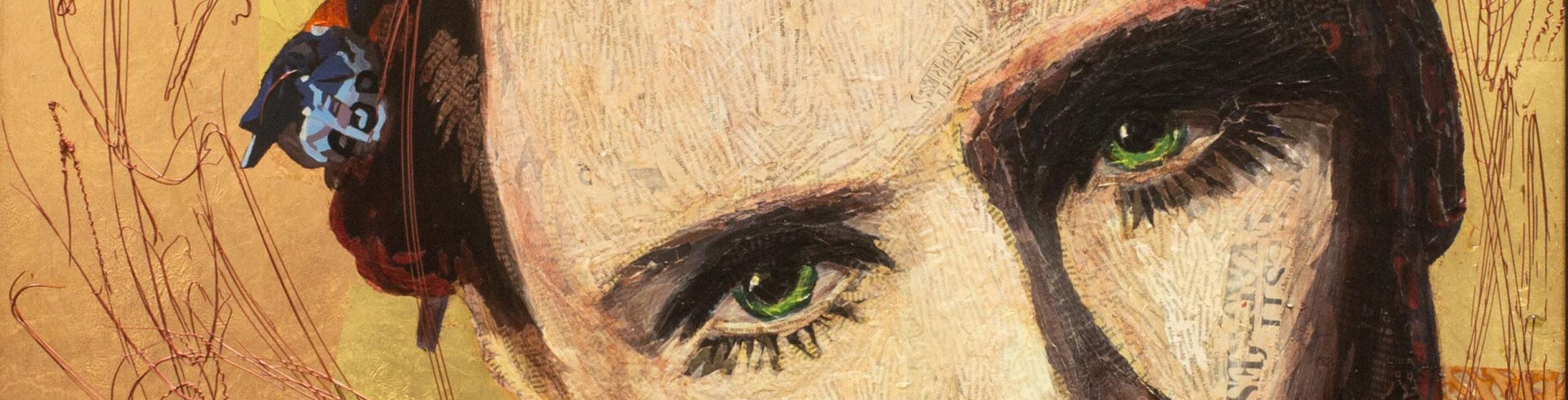
Often, her collages are also assemblages. The materials she uses are not only paper in various forms, but also fabric, plastic, and, in recent years, plywood. She is drawn to round formats of all kinds, which reinforce the idea of time and its cyclical nature. From her perspective, collage is less a technique and more a way to express an idea. It consists of fragments – seemingly random pieces that, when brought together into a whole, visually reference the surrounding reality. The nature of collage is inherently social, because its material comes from ephemeral print media. Yet under the artist’s hand, these fleeting scraps become timeless and enduring artworks.
Mall Nukke began making collages in the 1990s, almost by accident. At first, she used magazine images merely to trace elements for her works, mostly with colored pencils and pastels. When curator Eha Komissarov from Vaal Gallery offered her an exhibition, she was short on time and began replacing some drawn elements with collage. This emergency solution proved visually compelling, and while her early collages contained more drawing and painting than cutting and pasting, the proportions gradually shifted. Still, pure collage has never been her goal. She has always included painterly and spontaneous elements, like color splashes.
Later, she refined her method further, gluing together larger images from tiny snippets cut from advertising brochures, combining them with similar visuals. Layered gluing is technically demanding – the planning must be precise. First, the material is arranged on the surface. Then, she memorizes the image, removes the pieces, and begins gluing from the bottom layers upward. Both sides of the paper must be coated with glue, so that no edges curl up. Afterwards come multiple layers of varnish, acrylic and oil paint, and finally a protective top coat that gives the work a unified, durable surface.
Although we said everything starts with drawing, to be more accurate, everything starts with the surface. Mall Nukke constructs her collage supports herself, whether round, square, or uniquely shaped. The surface must be strong and inflexible, supported by a special inner frame, because the bigger the glued image, the greater the tension on the surface. She used to use wood glue, but now prefers acrylic medium, which has many advantages. Both, however, shrink as they dry; the water evaporates, the collage can curve, and the result may become unsuitable for display. It’s a game between liquid and solid materials, and “outsmarting” them can take weeks. But the effort pays off, as the result is visually solid and stable.
She gathers collage materials from everywhere – newspapers and magazines dating back to the 1960s, old phone books and directories, and also images found on Google, edited in Photoshop, and printed out when a specific detail can’t be sourced otherwise. Copyright rules must still be observed – nothing can be used as-is. Slippery slope? But that’s what pop art is – borrowing, quoting, commenting. But can we still call Mall Nukke a pop artist today? More likely, she has moved further into a space of her own, one that resists categorization, just as a well-built support resists warping under glue.
Triinu Soikmets, Art Historian
Exhibition views


 Sold
Sold
Participated in exhibition MALL NUKKE COLLAGE -
Sold 2025
 Not available
Participated in exhibition MALL NUKKE COLLAGE -

Participated in exhibition MALL NUKKE COLLAGE -
 Not available
Participated in exhibition MALL NUKKE COLLAGE -
 Not available
Participated in exhibition MALL NUKKE COLLAGE -

Participated in exhibition MALL NUKKE COLLAGE -
 Not available
Participated in exhibition MALL NUKKE COLLAGE -
 Not available
Participated in exhibition MALL NUKKE COLLAGE -
 Not available
Participated in exhibition MALL NUKKE COLLAGE -

Participated in exhibition MALL NUKKE COLLAGE -

Participated in exhibition MALL NUKKE COLLAGE -

Participated in exhibition MALL NUKKE COLLAGE -
 Not available
Participated in exhibition MALL NUKKE COLLAGE -

Participated in exhibition MALL NUKKE COLLAGE -

Participated in exhibition MALL NUKKE COLLAGE -
 Not available
Participated in exhibition MALL NUKKE COLLAGE -

Participated in exhibition MALL NUKKE COLLAGE -

Participated in exhibition MALL NUKKE COLLAGE -

Participated in exhibition MALL NUKKE COLLAGE -

Participated in exhibition MALL NUKKE COLLAGE -

Participated in exhibition MALL NUKKE COLLAGE -

Participated in exhibition MALL NUKKE COLLAGE -

Participated in exhibition MALL NUKKE COLLAGE -

Participated in exhibition MALL NUKKE COLLAGE -
 Not available
Participated in exhibition MALL NUKKE COLLAGE -

Participated in exhibition MALL NUKKE COLLAGE -