




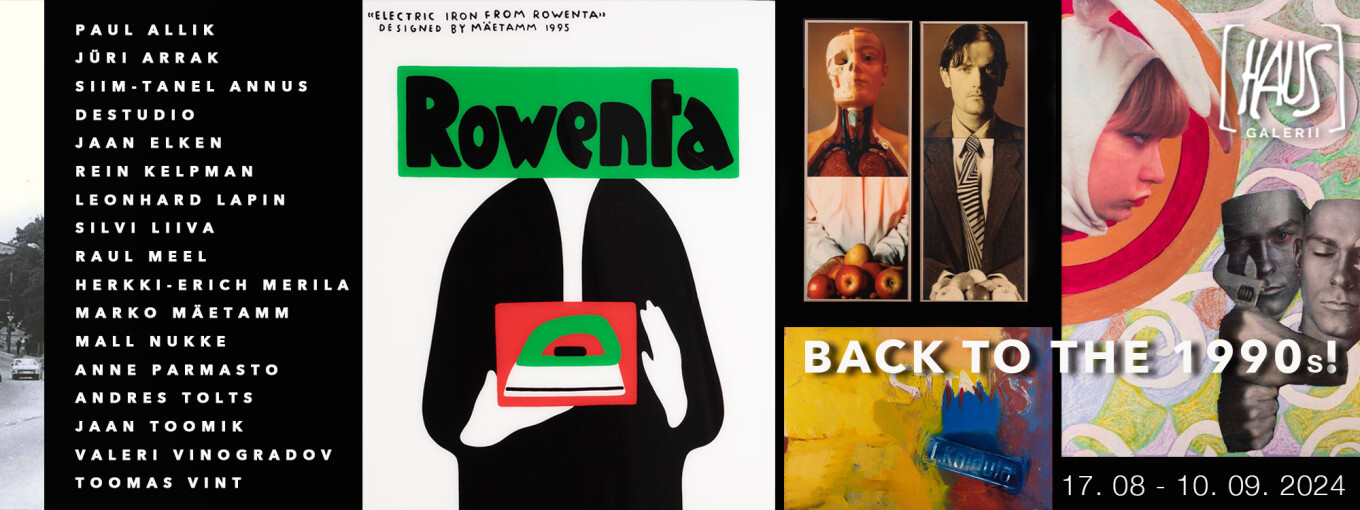


1990s in Estonian art BACK TO THE 1990s!
 -
-  Haus Gallery
August 1991, independence is restored again! Haus Gallery’s exhibition presents the art of this period, highlighting the works of several famous Estonian artists, each one with the creation year that starts with 199...
Text. Eero Epner
The 1990s were a difficult time for art: everything changed. In the previous decade painting flourished, new painters appeared and it seemed as everyone wanted to become a painter - or at least was interested in paintings.
With the arrival of new times, it all seemed to falter. Fresh winds brought interest in new techniques, styles and plots. Good old paintings suddenly began to seem old-fashioned, like a bomb tied to a leg that's rushing towards the future. Different views began to develop which lead to smaller civil wars and as usual during war-time there were eventually even talks about the death of painting. What was more vibrant than ever just a few years earlier was suddenly declared decayed. It was replaced by video art, installations, so-called bad painting, photography, performance art and so on.

Participated in exhibition BACK TO THE 1990s! -
 Sold
Sold
Participated in exhibition BACK TO THE 1990s! -
Sold 2025

Participated in auction ESTONIAN ART AUCTION - 1966 TO PRESENT
Participated in exhibition BACK TO THE 1990s! -

Participated in exhibition BACK TO THE 1990s! -
Participated in exhibition SINCE 1997

Participated in exhibition BACK TO THE 1990s! -
Participated in exhibition SINCE 1997

Participated in auction ESTONIAN ART CLASSICS, PART II
Participated in exhibition BACK TO THE 1990s! -
 Sold
Sold
Participated in auction ESTONIAN ART CLASSICS, PART II
Participated in exhibition BACK TO THE 1990s! -
 Not available
Participated in exhibition BACK TO THE 1990s! -
 Not available
Participated in exhibition BACK TO THE 1990s! -

Participated in exhibition BACK TO THE 1990s! -

Participated in exhibition BACK TO THE 1990s! -
 Not available
Participated in exhibition BACK TO THE 1990s! -

Participated in exhibition BACK TO THE 1990s! -
Participated in exhibition SINCE 1997

Participated in exhibition BACK TO THE 1990s! -
 Not available
Participated in exhibition BACK TO THE 1990s! -
PHOTOGRAPHY
DeStudio, Herkki-Erich Merila
Photography went through the opposite journey in terms of attention and status compared to painting. In the 1980s, photographers operated in separate clubs outside art galleries, and photography was not accepted as art. But in the 1990s, everything changed. There were many reasons for this, but mainly the DeStudio (Herkki-Erich Merila and Peeter Laurits) exhibitions in the first half of the 1990s must be highlighted. Having emerged with large and powerful works, DeStudio no longer approached photography narrowly, but the image as such, and in an era when everything was constantly changing, they realized that there is no longer a whole. For this reason, they often built their works from fragments, it is as if their works are first scattered into fragments and then glued back together in a new assembly. Not only the images were split, but also the identities - one of DeStudio's best-known works depicts the self-portraits of Merila and Lauritsa, but instead of a complete face, we see a fragmented collage. At the same time, both Merila and Laurits were also very well acquainted with the various technological solutions of photography. In the 1980s, both experimented with pinhole photography, which seems dreamy and poetic. Even then, Merila started with a new way of depicting the body, which only reached the work of other authors in the 1990s - he depicted male nudes, and instead of posing naked, we see groups of people in an abstract environment.
 Not available
Participated in exhibition BACK TO THE 1990s! -
 Not available
Participated in exhibition BACK TO THE 1990s! -
 Not available
Participated in exhibition BACK TO THE 1990s! -
 Not available
Participated in exhibition BACK TO THE 1990s! -
 Not available
Participated in exhibition BACK TO THE 1990s! -
GRAPHICS
Siim-Tanel Annus, Leonhard Lapin, Raul Meel, Silvi Liiva
Graphics had remained at a consistently high level since the 1960s and did not lose their high standards even in the 1990s. Siim-Tanel Annus, Leonhard Lapin, Raul Meel and Silvi Liiva were leading graphic artists already, although each of them approached art in their own way. Myths of the world found their place in Lapin's abundant creations - the cover image of this work is from Greek mythology, but interpreted conceptually and at the same time slightly erotically, typical of Lapin. Raul Meele's conceptualism had attracted wide international interest a long time ago. Meanings born from rhythmicity and repetition, which are also political - Meel uses images related to Estonia - remained relevant even in the 1990s. On the other hand, Silvi Liiva was more poetic on the surface, but there is also a certain seriousness and even darkness in her works. Philosophical devotions and attitudes unfold in the middle of delicate images. Annus’s pages are inspired by his trip to Japan. Japan has reached Estonian art before, for example, Evald Okas has several Japanese-themed graphic pages, but Annus is more general and abstract. He does not document travel impressions, but finds some greater truth and recognition, which also connects with his own inner searches.
 Not available
Participated in exhibition BACK TO THE 1990s! -
 Not available
Participated in exhibition BACK TO THE 1990s! -
 Not available
Participated in exhibition BACK TO THE 1990s! -
VIDEO
Jaan Toomik
Video art became the new art genre of the new era, and its most important author was Jaan Toomik, whose work immediately attracted unprecedented international attention. Today, his works belong to several private and museum collections all over the world. Like Raul Meel, Toomik often played with repetitions and amplifying seemingly random coincidences. Combining heartbeats and church bells was characteristically existential and sacred at the same time for Toomik, combining two such fundamental dimensions, but all this in the context of a miserable everyday life. In some ways, he could even be compared to Dostoevsky: lying in the dirt looking at the stars...

Participated in exhibition BACK TO THE 1990s! -

Participated in exhibition BACK TO THE 1990s! -

Participated in exhibition BACK TO THE 1990s! -

Participated in exhibition BACK TO THE 1990s! -

Participated in exhibition BACK TO THE 1990s! -
 Not available
Participated in exhibition BACK TO THE 1990s! -
 Not available
Participated in exhibition BACK TO THE 1990s! -

Participated in exhibition BACK TO THE 1990s! -